
Home » 2026
Yearly Archives: 2026
2026 IAHR Regional Conference and NAASR Annual Meeting
Challenges and Futures in Religious Studies
Pre-Conference Discussion
Friday, November 20
7:30-8:30p.m.
Stout Street Social
What is the form and function of a scholarly collective in today’s academia? In challenging times, we increasingly look to forge a sense of cohort and solidarity. Social formations along these lines, however, can be easier imagined than initiated because of the very challenges that motivate them. In this informal and off-site conversation, participants will return to a moment from our national meeting’s archive—specifically, Ivan Strenski’s frustrated take on the conditions under which academic societies meet to discuss research and socialize. Much has changed from that day to this, but the interest in forms of contact that rely on in-person configurations of time and space has resurfaced. What resources do we have at our disposal, and how can we make the most of this moment? What kinds of intellectual and institutional needs do we have, and how might NAASR rise to the occasion of meeting them?
There is limited space for this informal conversation; if you would like to reserve a spot, please email Craig Martin at cmartin@stac.edu.
Business Meeting
Saturday, November 21
9:30-10:00a.m.
Sheraton Governor’s Square 12
The Costs of Preserving Religious Studies
Saturday, November 21
10:00-11:00a.m.
Sheraton Governor’s Square 12
Lee Edelman writes that “For politics, however radical the means by which specific constituencies attempt to produce a more desirable social order, remains, at its core, conservative, insofar as it works to affirm a structure, to authenticate social order, which it then intends to transmit to the future in the form of its inner Child.” This session takes Edelman’s point seriously for religious studies, where the graduate student is quite literally the figure in whom the discipline invests its futurity. Each panelist – themselves PhD candidates trained on the field’s critical apparatus – offers a brief provocation from within Edelman’s frame, examining how the logic of disciplinary reproduction shapes what the field can imagine for itself: what counts as legitimate scholarship, what gets preserved and at what cost, and why alternatives that might require genuine transformation remain foreclosed in favor of transmitting the field as it already is. Their provocations then become the basis for a larger open conversation that asks not what religious studies owes its future but what its commitment to having one – in a specific, recognizable form – forecloses.
Presider: Jacob Barrett, University of North Carolina-Chapel Hill
Mackenzie Oglesby, University of North Carolina-Chapel Hill
Sam Herrmann, University of Pennsylvania
Challenges and Futures in Religious Studies
Saturday, November 21
1:00-2:30p.m.
Sheraton Governor’s Square 12
As the IAHR’s North American regional association, NAASR will be hosting a conversation at this year’s in-person meeting about the state of academia in this region. While the phenomenon of broad-scale institutional challenges is not new (guest editor Gary Lease devoted a special issue of MTSR in 1995 to the “pathologies” characterizing the study of religion in North American universities), the specific infrastructural characteristics of these challenges deserve our attention. Especially since our theoretical commitments ask us to examine the structural workings of power, we are in the intellectual position to explore this moment in higher education not only in terms of its machinations and effects but also in terms of prospective responses and resistances to the same.
We are assembling a discussion with a roundtable format to facilitate analysis that is as forthright and productive as possible. How should we respond to the rapidly changing economic and institutional landscape of academia? How can we demonstrate to our students the importance of thinking critically so as to give them language and tools for their own navigations of the social worlds in which they find themselves? What exactly is our work as scholars of religion in relation to the profession right now? To be clear, and in keeping with NAASR’s priorities regarding method and theory, these questions and their answers should not reinforce a theory/praxis binary. On the contrary, we want to assemble a group of thinkers who can put our particular skills to work in proactively undermining that very binary and demonstrating how needful our scholarship is in this moment.
To discuss the present challenges in and prospective futures of our field, roundtable participants are reading an essay from and about the past that remains strikingly relevant. Russell McCutcheon wrote “Looking Back on the Beginnings: An Historical Survey of Method & Theory Courses in Canada and the U.S.” in 1993 while a PhD student at the University of Toronto. A curricular time capsule from 33 years ago about courses on methods and/or theories across two North American countries stands as a jumping-off point for scholars today as we navigate a new academic generation’s institutional precarity. We encourage everyone to read the essay for themselves as context for the roundtable conversation. McCutcheon’s essay and a number of papers responding to it (including those stemming from the presentations in Denver) will be the material for next year’s Working Papers volume.
Rita Lester, Nebraska Wesleyan University
Marcel Parent, Concordia University
Jacob Barrett, University of North Carolina-Chapel Hill
Martha Smith, Fullerton College
NAASR and Equinox Publishing Reception
Saturday, November 21
7:00-9:00p.m.
Yard House, Sheraton Downtown
Religion Scholars (and Scholarship) and Rising Authoritariansim
Co-sponsored with the Redescribing Christian Origins Seminar of the SBL
Sunday, November 22
9:00-11:30a.m.
Colorado Convention Center, 606
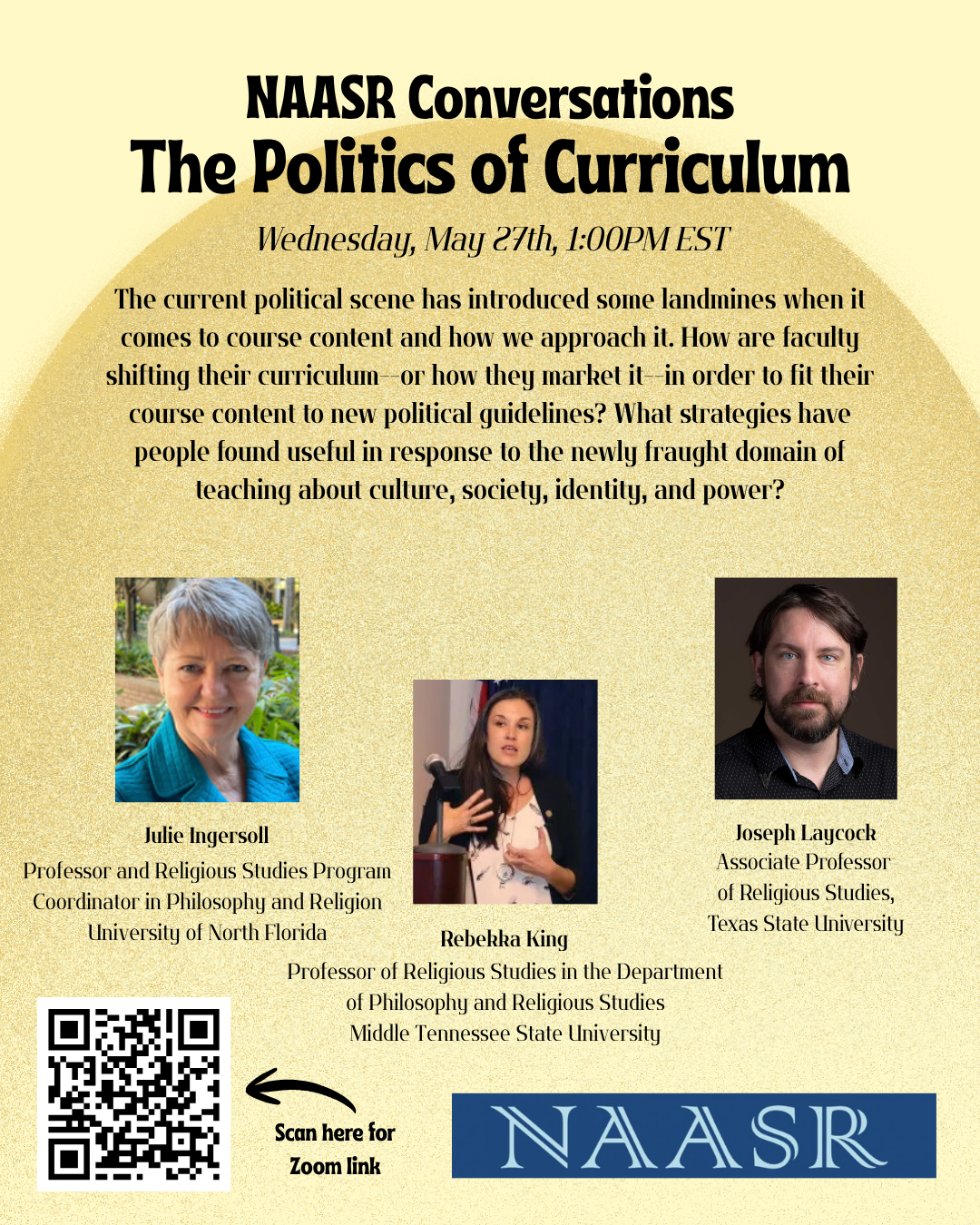
This is a roundtable discussion about the problems of the current political moment. Questions to be discussed include: How is the production of knowledge about early Christianity, and religion more broadly, being influenced or altered by the rise of authoritarianism in the US? Have the scholarly practices or topics of those who study religion been affected? What laws have been proposed or passed that regulate our curriculum, and how are we responding to them? What are the job prospects for PhD students, at a moment when Humanities departments are being defunded and/or dismantled? How are our departments and universities responding? What can we learn from how scholars in the past (or in other parts of the world, in the present moment) responded to authoritarian regimes and anti-intellectualism? What can our field and our expertise offer for making sense of this moment?
Presider: Andrew Durdin, Florida State University
Nicola Denzey Lewis, Claremont Graduate University
Joseph Laycock, Texas State University
Lara-Sophie Boleslawsky, University of Texas at Austin
Stephen Young, Appalachian State University
Rebekka King, St. Francis Xavier University
Michael Graziano, University of Northern Iowa
NAASR Annual Meeting 2026 CFP
Challenges and Futures in Religious Studies
#naasr2026
IAHR Regional Conference
In 1995, our journal Method and Theory in the Study of Religion devoted a special issue to “pathologies” in study of religion in North American universities. The guest editor—Gary Lease—wrote words that are as applicable today as they were then. Given widespread budget cuts, “Scarcely a month goes by that one does not hear of a department or programme in the study of religions closing or being mutilated.”
One of the main pathologies Lease identified was the inability of scholars to distinguish religious practice from the study of religion. The pathologies we face today, by contrast, have less to do with distinguishing theology from religion than the infrastructural changes taking place across higher education as a whole.
Today scholars of religion in North America face a panoply of challenges:
- a caricature of the humanities and social sciences as useless at best, or a radical threat to traditional social norms at worst;
- an increasingly transactional view of education, according to which the only relevant goal of a college education is job training;
- the rise of LLMs, which has required a complete rethinking of our pedagogical goals and methods;
- a declining focus with students on sustained reading and reading comprehension in general;
- a neoliberal overhaul of university management and budgets, requiring departments to meet metrics that gauge efficiency above all other measures;
- and more.
Inasmuch as our analytical commitments ask us to examine the structural workings of power, we are in the intellectual position to explore authoritative systems not only in terms of their machinations and effects but also in terms of social responses and resistances to the same.
We are also well served to remember that academia and the work we do inside it are ever-evolving phenomena even in contexts of relative comfort and stability. This reminder helps us think and respond with more sophistication to the current moment, treating it not as exceptional but rather as deserving of our critical attention—no more or less.
The challenges we face are felt across the continent (and, in various ways, around the world). In its role as the North American affiliate of the International Association of the History of Religion, NAASR will host a regional meeting of the IAHR to facilitate a conversation among scholars from Canada, Mexico, and the United States that brings our theoretical expertise to bear on this institutional perfect storm.
How should we respond to the rapidly changing economic and institutional landscape of academia? How can we demonstrate to our students the importance of thinking critically so as to give them language and tools for their own navigations of the social worlds in which they find themselves? What exactly is our work as scholars of religion in this sociopolitical/economic/institutional moment?
The 2026 program will retain last year’s conversational, roundtable format. To that end, individual submissions for individual presentations should consist simply of a brief (500-word max) abstract. Include your name, institution, and email address on your submission.
In lieu of submitting full papers in advance of the meeting, participants will submit an outline of key ideas (and a brief annotated bibliography, if relevant) in early October 2026. Ultimately, the aim is to publish these sessions as an edited volume within the NAASR Working Papers series with Equinox. Therefore, by submitting a proposal for the annual meeting, you are agreeing to contribute a version of your remarks as a chapter in said volume. While the program will emphasize a conversational format with only informal notes due in advance, full-length essays (roughly 3,000-4,000 words) will be due by February 28, 2027.
Proposals are due by April 28 at 5pm EST via an email to Merinda Simmons (merinda.simmons@ua.edu) with the subject line “NAASR 2026 Proposal.”
We hope to make participation as accessible as possible. Limited travel support may be available for participants with financial need. Please indicate in your submission if you would like to be considered.
Direct any questions about this process to Merinda as well.
***
CFP for our annual co-sponsored panel with the Redescribing Christian Origins unit of the SBL:
We invite papers that address the academic study of religion under authoritarian regimes.
- How does authoritarian power shape the way scholars imagine/understand/theorize religion?
- How have scholars of religion censored themselves?
- How has some scholarship served authoritarianism or nationalist ideologies?
The panel is particularly interested in approaching this topic with questions about the critical study of religion, its complicities, its resistances, and its various relationships with this phenomenon.
We especially encourage scholars from traditionally marginalized groups to submit their work.

