
Home » Articles posted by naasreligion (Page 7)
Author Archives: naasreligion
“…But What Do You Study?”: A NAASR Workshop on Succeeding in the Job Market
1pm – 5pm Sunday, November 20 (alongside AAR/SBL)
This session proposes to explore the employment challenges facing early career scholars who are interested in issues of theory & method in the study of religion, through both a discussion and workshop. This session addresses issues important to junior NAASR members (notably, but not exclusively, ABDs now entering/about to enter the job market) by demonstrating how a professional organization can provide a practical and strategic forum for job-market advice.
The following activities will take place during the session:
I. Workshop
In the first half of the session, participants will break into small groups, each led by a more senior scholar. Within their groups, participants will discuss in focused ways how they might best represent themselves, their work, and their scholarly interests on the job market. The smaller setting will allow for more “hands on” advice, taking as examples the CV and cover letters the organizers will have pre-distributed among participants. Simply focusing on what one says in a cover letter’s opening paragraph, for example, or how one orders a C.V., will provide the way into larger questions of representation in these small group discussions. Participants should be ready to share and discuss their CV and sample cover letter with fellow group members (though hopefully all will have some familiarity with the materials in advance to facilitate a more focused workshop).
II. Open Discussion
With the issues and questions from the small-group workshop in mind, the second half of the session will be devoted to an open discussion. The group leaders will begin by providing brief introductory remarks on what they each see as constructive and strategic advice for early career scholars who are navigating the academic job market, aimed initially at how applicants can be strategic not only in trying to ascertain a Department’s needs but also in negotiating potential theoretical and political landmines in the field. A discussion will follow in which participants can talk about these issues in an informal atmosphere and share information. This guided discussion will focus on four central questions related to how might early career scholars interested in theory and method:
- represent themselves strategically on the job market?
- apply to calls for general positions, fitting themselves to broad departmental needs?
- shape their cover letters and CVs to appeal to a wide range of departments?
- respond to critiques that they have no “specialty,” “content,” or “area of study”?
The discussion is designed to reflect different opinions regarding the place of theory & method in the job market, as well as in the study of religion more generally.
**
Scholars of all concentrations within the field of Religious Studies are welcome to join the workshop—whether a NAASR member or not—though preference will be given to early career scholars, particularly those at the senior ABD stage (i.e., those already on or going onto the job market). Shortly before the workshop, but once the participants have been identified, each participant will be invited to share with the other members, via email or a closed social media group, their academic focus/dissertation topic, level of teaching experience, their level of experience with the job market as well as their own current position (e.g., PhD Student, Postdoc, Instructor, etc.) in order to ensure all participants come to the meeting somewhat familiar with the diversity of experience in the workshop. In addition, as stated above, each participant will be invited to provide a sample cover letter and CV for the organizers to pre-distribute. These materials will then be workshopped within their small groups. More details will follow after the participant list has been finalized.
Space is limited to 25 participants in this NAASR workshop. To register, please e-mail the organizer, Michael Graziano (grazmike [at] gmail [dot] com) by no later than October 15, 2016. In this request to register please include your current degree or professional career stage.
Program Schedule Posted for Annual Meeting in San Antonio
To view the program schedule, click here.

Books of Interest: Religion and Magic in Western Culture
 Daniel Dubuisson, Religion and Magic in Western Culture (Brill, 2016).
In the history of Western culture, theology, and science, a strict dichotomy exists between religion and magic: religion as the intellectually and morally superior one – magic as the primitive, superstitious, demonic other.
The present work aims to break with this tradition, and traces the origin of this dichotomy as well as its many purposes. Whose powers does it serve? Which interests and ideological stakes does it conceal?
Moreover, the author proposes a new epistemological framework for the study of magisms as well as their “rehumanisation”, and argues for a rehabilitation of their studies.
Books of Interest: New Patterns for Comparative Religion
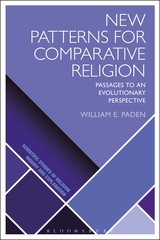 William E. Paden, New Patterns for Comparative Religion: Passages to an Evolutionary Perspective (Bloomsbury, 2016).
The cross-cultural study of religion has always gone hand in hand with the worldview, sciences, or intellectual frameworks of the time. These frames, whether focused on psychology or politics, gender or colonialism, bring out perspectives for understanding religious behavior. Today one of our common civic worldviews is represented in the shift from scriptural to evolutionary history.
This volume brings together in one place key essays by professor emeritus William Paden, showing a progression of steps he has taken in exploring bridgeworks between comparative religion and evolutionary models of religious behavior. One of the leading scholars in religious studies, Paden shows ways that religion can be contextualized as part of the natural world and thus seen as reflecting the ingrained sociality and world-making drive of the human species.
Paden argues that although comparativism has been challenged as too culture-bound, too western, or too gendered, cross-over categories and concepts between religious traditions cannot be avoided. Arguing that there are recurrent patterns of human behavior common to our species and that thereby underlie all cultures, he proposes that the missing link in the Religion Evolution debate is comparative religion, a global, cross-cultural perspective on religious behaviours throughout time. Each article is contextualized within this overall trajectory of thought within Paden’s work and the history of the discipline as a whole. – See more at: http://www.bloomsbury.com/us/new-patterns-for-comparative-religion-9781474252119/#sthash.yrKxX8h0.dpuf
Books of Interest: The Mind of Mithraists
 Now in paperback!
Luther H. Martin, The Mind of Mithraists: Historical and Cognitive Studies in the Roman Cult of Mithras (Bloomsbury, 2014).
The Roman cult of Mithras was the most widely-dispersed and densely-distributed cult throughout the expanse of the Roman Empire from the end of the first until the fourth century AD, rivaling the early growth and development of Christianity during the same period. As its membership was largely drawn from the ranks of the military, its spread, but not its popularity is attributable largely to military deployments and re-deployments. Although mithraists left behind no written archival evidence, there is an abundance of iconographic finds. The only characteristic common to all Mithraic temples were the fundamental architecture of their design, and the cult image of Mithras slaying a bull. How were these two features so faithfully transmitted through the Empire by a non-centralized, non-hierarchical religious movement? The Minds of Mithraists: Historical and Cognitive Studies in the Roman Cult of Mithras addresses these questions as well as the relationship of Mithraism to Christianity, explanations of the significance of the tauroctony and of the rituals enacted in the mithraea, and explanations for the spread of Mithraism (and for its resistance in a few places).
The unifying theme throughout is an investigation of the “mind” of those engaged in the cult practices of this widespread ancient religion. These investigations represent traditional historical methods as well as more recent studies employing the insights of the cognitive sciences, demonstrating that cognitive historiography is a valuable methodological tool.
NAASR Note: New Executive Officer
 A subcommittee of NAASR’s executive council nominated Brad Stoddard as the person to follow Craig Martin as NAASR’s next Executive Secretary/Treasurer, as Craig’s 5-year term ends this summer. Although originally appointed to the nominating committee himself (inasmuch as he is a member of the executive), Brad excused himself when conversations turned to his possible candidacy. And the executive has now voted by email and agrees with their nomination. So we’re happy to announce that Brad—a tenure-track professor at McDaniel College (where, by the way, he works with former NAASR President, Greg Alles) and grad of Florida State, who studies, among other things, the role of religion in the US’s prison system—will assume this role when Craig’s term ends.
You may have seen Brad on a variety of NAASR panels or participating in some of our workshops, over the past few years. He’s also involved in The Religious Studies Project—so he’s already an active member of the field and has the energy and organizational skills to follow Craig and to keep Craig’s innovations moving in the right direction.
Announcement: 2016 NAASR Program

Method Today
With the success of the 2015 NAASR program—devoted to examining the current state of theory in the study of religion with four main papers plus responses—the 2016 program will retain the same format but turn its attention instead to the closely related topic of method. And because of the wide variety of methods used in the cross-disciplinary study of religion, we’re proposing narrowing the focus to four key tools that all scholars of religion surely employ, regardless their approach to the study of religion: description, interpretation, comparison, and explanation.
Description: Naomi Goldenberg (University of Ottowa)
Respondents:
Emily Crews (University of Chicago)
Ian Cuthbertson (Queen’s University)
Neil George (York University)
Dan McClellan (University of Exeter)
Interpretation: Kevin Schilbrack (Appalachian State University)
Respondents:
Mark Gardner and Steven Engler (Mount Royal University)
Joshua Lupo (Florida State University)
Matt Sheedy (University of Manitoba)
Jennifer Eyl (Tufts University)
Comparison: Aaron W. Hughes (University of Rochester)
Respondents:
Lucas Carmichael (University of Colorado)
Thomas Carrico (Florida State University)
Drew Durdin (University of Chicago)
Stacie Swain (University of Ottawa)
Explanation: Ann Taves and Egil Asprem (University of California—Santa Barbara)
Respondents:
Spencer Dew (Centenary College)
Joel Harrison (Northwestern University)
Paul Kenny (SOAS, UK)
Erin Roberts (University of South Carolina)
Examining each of these in turn will open conversations on far wider topics of relevance to NAASR’s mission, such as description being intimately linked to ethnography, viewpoint, first person authority (to name but a few). In much the same way, detailed consideration of the other three tools also leads into conversations on the basics of the field. For instance, having survived critiques of comparison as ethnocentric, what is the future of comparative studies and how ought they to be carried out? Given the once dominant, but for some now discredited, place of hermeneutical approaches what is entailed in the interpretation of meaning today? And, despite their once prominent place several generations ago, what does one make of the continuing lack of interest in the academy in naturalistic, explanatory theories of religion? This focus on method, by means of these four basic tools, therefore will provide us with an opportunity to assess the current state of the field.
The four main papers will be pre-circulated to members prior to the conference, and thus will only be summarized briefly at their sessions; the remainder of the sessions will be devoted to responses and open conversation. In addition, all of the papers will be published in a future, special issue of MTSR.
Books of Interest: Philosophy and the End of Sacrifice
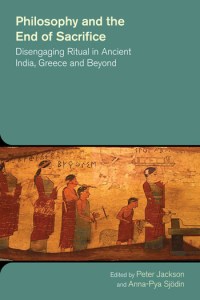 Peter Jackson and Anna-Pya Sjödin (eds.), Philosophy and the End of Sacrifice: Disengaging Ritual in Ancient India, Greece, and Beyond (Equinox 2016).
This volume addresses the means and ends of sacrificial speculation by inviting a selected group of specialist in the fields of philosophy, history of religions, and indology to examine philosophical modes of sacrificial speculation — especially in Ancient India and Greece — and consider the commonalities of their historical raison d’être. Scholars have long observed, yet without presenting any transcultural grand theory on the matter, that sacrifice seems to end with (or even continue as) philosophy in both Ancient India and Greece. How are we to understand this important transformation that so profoundly changed the way we think of religion (and philosophy as opposed to religion) today? Some of the complex topics inviting closer examination in this regard are the interiorisation of ritual, ascetism and self-sacrifice, sacrifice and cosmogony, the figure of the philosopher-sage, transformations and technologies of the self, analogical reasoning, the philosophy of ritual, vegetarianism, and metempsychosis.
CFP: Concepts in the Study of Religion
 The following new book series—published in association with NAASR—might be of interest to members; see the publisher’s site for more information.
Books in the series Concepts in the Study of Religion: Critical Primers offer brief introductions to an array of concepts—modes of analysis, tools, as well as analytic terms themselves—within the discourse of religious studies. Useful for almost any course, the volumes in the series do not attempt to assert normative understandings but rather they introduce and survey the various modes and contexts for scholarly engagement with the concept at hand. How, for example, has the term ‘myth’ been used, and what can various definitions allow us to do as scholars? Who in the field is working on the category of race and how? What might be the future of scholarship on gender in religious studies? What are the possibilities and limitations of description or comparison as methodological approaches? Thus, these critical primers provide — but are not limited to — concise overviews of the history of an approach or term. They also present the authors’ own critical analyses of the dynamics and stakes present in discourses surrounding these concepts. Featuring lists of further readings to guide additional consideration of their topic, the books in this series are valuable resources for students and advanced scholars alike.
Series Editor
K. Merinda Simmons, University of Alabama
CFP: Critiquing Religion: Discourse, Culture, Power
 The following new book series might be of interest to NAASR members; download this pdf for more information.
Critiquing Religion: Discourse, Culture, Power publishes works that historicize both religions and modern discourses on ‘religion’ that treat it as a unique object of study. Using diverse methodologies and social theories, volumes in this series view religions and discourses on religion as commonplace rhetorics, authenticity narratives, or legitimating myths which function in the creation, maintenance, and contestation of social formations. Works in the series are on the cutting edge of critical scholarship, regarding ‘religion’ as just another cultural tool used to gerrymander social space and distribute power relations in the modern world. Critiquing Religion: Discourse, Culture, Power provides a unique home for reflexive, critical work in the field of religious studies.
Senior Editor
Craig Martin, St. Thomas Aquinas College
Editorial Board
Richard King, University of Kent
Bruce Lincoln, University of Chicago
K. Merinda Simmons, University of Alabama
Leslie Dorrough Smith, Avila University
Hugh Urban, Ohio State University

