
Home » Articles posted by naasreligion (Page 10)
Author Archives: naasreligion
Announcement: Job Posting for Ludwig-Maximilians-University Munich
 The Chair of Religious Studies (Prof. Dr. Robert Yelle) in the Faculty for Philosophy, Philosophy of Science and Religious Studies at LMU Munich, seeks beginning with October 1, 2015: A scientific co-worker (PhD candidate—part time 65%).
Tasks:
- Research on your own PhD project and in the general field of the Chair.
- Teaching in the amount of 3.25 semester hours, as well as student advising.
- Active participation in the administration of the academic program.
- Scientific development is an intergral component of the work and will be actively supported.
For more information please see this pdf.
CFP: Religion and Journalism
 Religion, a leading peer-reviewed journal in the study of religions, seeks submissions for a special issue on “Religion and Journalism.”
If religion is in the news, this is the result of journalism. Journalists put religion on the agenda. Moreover, many religious groups have their own newspapers and magazines and forms of journalism.
The editors invite the submission of academic articles addressing any aspect of this theme, including but not limited to the following: forms of religious journalism; the representation of religion by journalists; journalists as religious agents; changes and challenges in the work of covering religions; insider/outsider dynamics in religion reporting; global and national trends in religion coverage (thematic and structural); ethical challenges of reporting on religion; impact of new technologies on these issues; etc.
For more information, see the journal’s website here.
Books of Interest: Religion as a Category of Governance and Sovereignty
 Trevor Stack, Naomi R. Goldenberg, and Timothy Fitzgerald (editors), Religion as a Category of Governance and Sovereignty (Brill, 2015).
Religious-secular distinctions have been crucial to the way in which modern governments have rationalised their governance and marked out their sovereignty – as crucial as the territorial boundaries that they have drawn around nations. The authors of this volume provide a multi-dimensional picture of how the category of religion has served the ends of modern government. They draw on perspectives from history, anthropology, moral philosophy, theology and religious studies, as well as empirical analysis of India, Japan, Mexico, the United States, Israel-Palestine, France and the United Kingdom.
“…But What Do You Study?”: A NAASR Workshop on Theory & Method in the Job Market
This session, to be held as a part of the NAASR program this November in Atlanta, proposes to explore the employment challenges facing early career scholars who are interested in issues of theory & method in the study of religion, through both a discussion and workshop. This session addresses issues important to junior NAASR members (notably, but not exclusively, ABDs now entering/about to enter the job market) by demonstrating how a professional organization can provide a practical and strategic forum for job-market advice.
The following activities will take place in this 90 min. workshop:
1. Open Discussion
The first half of the session will be devoted to an open discussion, led by Martha G. Newman (University of Texas at Austin) and Merinda Simmons (University of Alabama). Each will begin by providing brief introductory remarks (approx. 5 minutes each) on what they each see as constructive and strategic advice for early career scholars who are navigating the academic job market, aimed initially at how applicants can be strategic not only in trying to ascertain a Department’s needs but also in negotiating potential theoretical and political landmines in the field. A discussion (35 min.) will follow in which participants can discuss these issues in an informal atmosphere and share information. This guided discussion will therefore focus on four central questions, namely, how might early career scholars interested in theory and method:
- represent themselves strategically on the job market?
- apply to calls for general positions, fitting themselves to broad departmental needs?
- shape their cover letters and CVs to appeal to a wide range of departments?
- respond to critiques that they have no “specialty,” “content,” or “area of study”?
The discussion is designed to reflect different opinions regarding the place of theory & method in the job market, as well as in the study of religion more generally.
2. Workshop
In the second half, participants will break into small groups, each led by a more senior NAASR member. Building on the previous discussion, participants will work within their groups to workshop how they might best represent themselves, their work, and their scholarly interests on the job market. The smaller setting will allow for more “hands on” advice, taking as examples the CV and cover letters participants can bring with them to the session. Simply focusing on what one says in a cover letter’s opening paragraph, for example, or how one orders a C.V., will provide the way into larger questions of representation in these small group discussions. Participants in this section will have an opportunity to work with John E. Llewellyn (Missouri State), Russell McCutcheon (University of Alabama), Martha G. Newman (University of Texas at Austin), Steven Ramey (University of Alabama), and Merinda Simmons (University of Alabama).
Scholars of all concentrations within the field of Religious Studies are welcome to join the workshop—whether a NAASR member or not—though preference will be given to early career scholars, particularly those at the senior ABD stage (i.e., those already on or going onto the job market). Shortly before the workshop, but once the participants have been identified, each participant will be invited to share with the other members, via email or a closed social media group, their academic focus/dissertation topic, level of teaching experience, their level of experience with the job market as well as their own current position (e.g., PhD Student, Postdoc, Instructor, etc.) in order to ensure all participants come to the meeting somewhat familiar with the diversity of experience in the workshop. In addition, each participant will be invited to bring one sample cover letter and one sample CV which may be used in the small group activities. More details will follow after the participant list has been finalized.
Space is limited to 25 participants in this NAASR workshop. To register, please e-mail the organizer, Michael Graziano (mgraziano@fsu.edu) by no later than June 15, 2015. In this request to register please include your current degree or professional career stage.
CFP: Bulletin for the Study of Religion
 As one of NAASR’s journals, the editors of the Bulletin for the Study of Religion wish to extend a warm invitation to NAASR members to contribute articles, review essays, interviews, response articles, and announcements.
The Bulletin is the premiere non-refereed journal in the academic study of religion, publishing articles addressing method & theory in the study of religion, history of the discipline, pedagogical reflections, and accessible research arising from various area studies. The Bulletin has a long history of engaging and challenging both theoretical and professional trends in the study of religion.
Articles range in length from 3000 to 7000 words. Both standalone pieces and panels of papers are welcome. Guidelines are available online here. Please address any queries to the editor, Philip L. Tite (philip.tite@mail.mcgill.ca or titep@uw.edu), or the managing editor Arlene Macdonald (almacdon@utmb.edu).
NAASR Note: Religious Studies, Liberal Arts, and the Public University
***Deadline extended to 31 January 2015***
The following CFP might be of interest to NAASR members:
Religious Studies, Liberal Arts, and the Public University
The conference will examine religious studies methods, curriculum, pedagogy, and ethos in terms of the field’s relationship to two key social locations, the liberal arts and the public university. Proposals are invited for papers and presentations on this theme. The organizers are particularly interested in the following topics: the intersection or disjunction of religious studies methods with the fields of humanities and social sciences; what religious studies contributes to liberal education; disciplinary ethos in the context of public universities bound by the First Amendment; the public university as fertile context for religious studies as an analytical discipline; history of religious studies at public universities; curricular and pedagogical challenges of religious studies in both liberal arts and public university contexts; the departmental model and its alternatives, especially the presence of religious studies as part of multidisciplinary departments; the articulation of the value of religious studies in an age of austerity; and particular challenges for religious studies in online or hybrid pedagogy. Proposals falling under the conference title but not specifically listed here will also be considered. Please send proposals (250 word maximum) by email attachment to Professor Rebecca Raphael at rr23 at txstate dot edu by January 31, 2015. The conference will be held April 10-11 at Texas State University, San Marcos, TX. Sponsored by the College of Liberal Arts, the Department of Philosophy, and the NEH Distinguished Teaching Professor in Humanities.
Books of Interest: Religious Discourse in Modern Japan
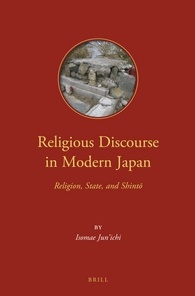 Isomae Jun’ichi, Religious Discourse in Modern Japan (Brill 2014).
Religious Discourse in Modern Japan explores the introduction of the Western concept of “religion” to Japan in the modern era, and the emergence of discourse on Shinto, philosophy, and Buddhism. Taking Anesaki’s founding of religious studies (shukyogaku) at Tokyo Imperial University as a pivot, Isomae examines the evolution of this academic discipline in the changing context of social conditions from the Meiji era through the present. Special attention is given to the development of Shinto studies/history of Shinto, and the problems of State Shinto and the emperor system are described in relation to the nature of the concept of religion. Isomae also explains how the discourse of religious studies developed in connection with secular discourses on literature and history, including Marxism.
Books of Interest: Chasing Down Religion
 Panayotis Pachis and Donald Wiebe (eds.), Chasing Down Religion: In the Sights of History and the Cognitive Sciences (Equinox 2014)
Whether as a historian finding solutions to unresolved problems or as a scientist finding the causes for events and actions, Luther Martin’s primary focus has been to get to the roots of the religious impulse in human existence. This collection of essays from scholars of his own generation and from his best students cover the three major strands of his work: the Greco-Roman world, cognitive science approaches to explaining religious phenomena and methodological issues in the academic study of religions. The contributions build on the work of Luther Martin and further the ongoing discussion and debate within these areas of religious studies.
2015 Call for Proposals: Theory in a Time of Excess
Although the terms “method and theory” can now be found in course titles, curricula/degree requirements, area/comprehensive exams, and listed as competencies on the CVs of scholars from across a wide array of subfields, and while a variety of groups at annual scholarly conferences itemize theorizing among the topics that they routinely examine, it seems that few of the many examples of doing theory today involve either met-reflection on the practical conditions of the field or rigorously explanatory studies of religion’s cause(s) or function(s). So, despite the appearances of tremendous advances in the field since NAASR’s founding as the lone place for carrying out theory in the study of religion—when “theory” was indeed a rare word and was often replaced with the more neutral “approach”—it can be argued that little has changed.
The upcoming 2015 meeting in Atlanta marks the organization’s 30th anniversary and so the NAASR program will be divided into two related parts: (i) an invited Presidential Panel on the history of NAASR and the changing (or not) circumstances of its present and possible future and (ii) four separate panels (all leading up to the Presidential Panel), two hours in length each, all exploring a variety of views on how one carries out theorizing in the academic study of religion today—when almost everyone claims to be a theorist but few seem to do theory.
Each of the four panels will focus on one substantive statement on what theory is (or is not) and what can (or cannot) be accomplished by adopting a particular understanding of the requirements of theorizing in the human sciences. This call for proposals is therefore devoted to having NAASR members submit approx. 250 word abstracts from which the Program Committee will select four papers, each of which presses members to consider different issues involved with defining and doing theory in the academic study of religion. The abstract must make clear the submitters understanding of what constitutes theory while also summarizing the direction of his/her argument and any examples/data domains with which the presenter will work.
Note: Proposals selected will need to result in substantive and original essays, of approx. 4,000-5,000 words in length, that will be submitted to NAASR in PDF form by no later than October 1, 2015, for pre-distribution to all members. Also, these papers will not be read in Atlanta but, due to the pre-distribution, presenters will have 15 minutes to orally summarize their arguments. Respondents will then be invited by the Program Committee to work with each paper, applying and testing its argument.
Our goal is to publish the collection in MTSR or another appropriate venue.
Submit all proposals, by no later than February 15, 2015, as PDF file attachments to:
Prof. Aaron Hughes
NAASR Vice President and Chair of the Program Committee
University of Rochester
aaron.hughes at rochester dot edu

